
Fayette County Arrest Records Path
A Fayette County arrest record usually starts at the custody level. A person is arrested or picked up on a warrant, booked into the Fayette County Jail, and entered into the sheriff's app-backed inmate feed if the booking is published. That entry may show the person's name, booking number, booking date, demographics, charge text, and sometimes an image. It does not prove that the charge is final. It also does not prove guilt. The court side starts when the case is filed in the Alabama court system, when a warrant is returned to court, or when the prosecutor chooses the formal charge.
Fayette County criminal prosecutions are handled through the 24th Judicial Circuit District Attorney, led by Andrew "Andy" Hamlin. The circuit covers Fayette, Lamar, and Pickens Counties. The DA may file the same charge shown at booking, amend it, reduce it, dismiss it, or present a matter for grand-jury action when the facts and law support that path. For custody and booking details, use Fayette County jail inmate records. For booking photos, use Fayette County jail mugshots. The court record is the place to verify formal charges and later disposition.
Find Fayette County Court Charges
The main online court lookup channel is Alabama Trial Court Records, or Alacourt. The local court site is the Fayette County courts site, and the Circuit Clerk page names Samantha Howard as Circuit Clerk. Alacourt is the case-record path for charges after a jail arrest, while the sheriff's OCV feed is a custody roster. The two systems answer different questions. The roster answers, "Is this person in the jail feed?" The court record answers, "What case was filed, what charges are pending, and what happened next?"
- Open the statewide Alacourt public-access portal and choose the court-record search path available to the public.
- Search by party name if no case number is known. Use Fayette County as the county filter when the portal offers that choice.
- Use a case number from court paperwork when available, because it is more exact than a name search.
- Open the case and read each charge separately. One arrest can produce more than one count or case.
- Check the status, disposition, and any bond or release-condition entries before treating the record as current.
The Fayette County Circuit Clerk is the local fallback for older files, certified copies, case-number questions, and records that do not show in the public portal. Some Alacourt access may require registration, payment, or a different access level. For official statewide criminal-history access, the ALEA Alabama Background Check process is separate from a same-day court charge search.
The Alacourt public-access portal is the statewide entry point for Alabama trial court records, including Fayette County matters when available through the portal.
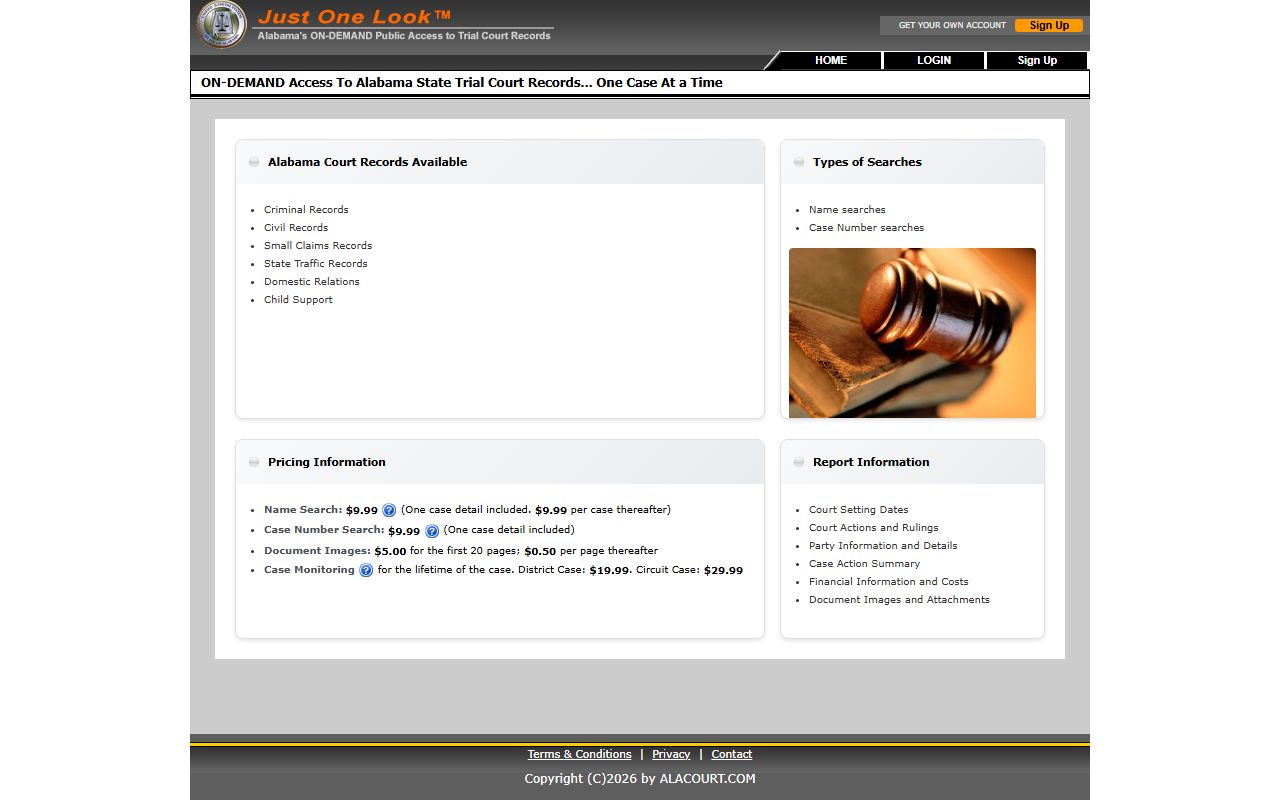
Use the portal result as a court-record lead, then confirm certified copies or older paper files with the Fayette County Circuit Clerk.
Fayette County Court Search Fields
Alacourt search controls can vary by workflow and access level, but the research found the main fields a Fayette County user should expect. A name search is useful when the only known fact is the defendant's name from the jail roster. A case-number search is better when a bond form, subpoena, complaint, traffic citation, or clerk notice gives a precise number. Court type also matters because municipal, district, and circuit cases may not sit in the same place in a user's search results.
| Field Label | Type | Required | Notes |
|---|---|---|---|
| Party / Name search | Text | Varies | Use the defendant name from the booking entry, and try spelling variants when needed. |
| Case Number | Text | Optional unless doing exact lookup | Best for matching a known court file to a jail arrest. |
| County | Dropdown or filter | Important | Select Fayette County when searching a local Alabama case. |
| Court type | Dropdown or filter | Portal dependent | District, Circuit, Municipal, or other court distinctions may apply. |
| Search / Submit | Button | Yes | The portal may require terms, account access, or fees for full detail. |
Names in the Fayette County Jail feed are commonly shown last name first. Court records may use middle initials, suffixes, maiden names, or other variations. If a search misses, use a broader name query and compare the case date, charge text, and court location before assuming the person has no court record.
Fayette County Charging Records
After an arrest, the charge record may be created through a complaint, information, or indictment. The sheriff's roster can show plain charge text such as a sentence, alias writ of arrest, or named offense. Court charging documents are different. They are the papers that place the allegation before the court, identify the defendant, and set the legal charge or count that will be litigated.
| Document | Who Usually Starts It | How It Fits After Arrest |
|---|---|---|
| Complaint | Officer, complainant, or prosecutor process | A sworn charging document often used to start a criminal case after arrest or warrant action. |
| Information | Prosecutor | A prosecutor charging document used where Alabama procedure permits that filing path. |
| Indictment | Grand jury | A grand-jury accusation, often tied to felony prosecution after review of the evidence. |
Formal charges can be broader, narrower, or different from the jail's booking charge. A roster line is often an intake label. A court charge is a case allegation. The difference matters for Fayette County arrest records because a person may be booked on one basis, later charged in a different form, or released while the prosecutor reviews the file.
Fayette County Charge Status
Charge status changes as a case moves. Pending means the court has not reached a final outcome. Amended or reduced means the filed charge changed. Dismissed means the charge ended without a conviction. Nolle prosequi, often shortened to nol-pros, means the prosecutor declined to proceed on that charge. These words should be read at the charge level, because one case can contain several counts with different outcomes.
| Status | What It Means |
|---|---|
| Pending | The case or charge remains open, and no final disposition has been entered for that charge. |
| Amended | The filed charge was changed, which may add, correct, or alter the allegation. |
| Reduced | The charge changed to a lesser offense or lesser count as the case moved forward. |
| Dismissed | The charge ended without a conviction on that count. |
| Nolle Prosequi | The prosecutor chose not to continue with that charge at that time. |
| Disposition | The final result, such as conviction, dismissal, acquittal, plea, or other case outcome. |
The Fayette County Jail feed does not show every court field. Inspected entries did not show case number, statute code, judge, court date, charge class, or final disposition. That is why court records and clerk confirmation matter after a jail arrest.
Bond After Fayette County Arrest
Bond and release conditions sit between the jail record and the court record. The Fayette sheriff research did not locate an official local bond-payment page, online bond portal, fee list, or separate bond office hours. For a current bond question, call the Fayette County Sheriff's Office at (205) 932-3205 or ask at the public counter. For case and court setting questions, use Alacourt or contact the Fayette County Circuit Clerk.
| Bond Type | How It Works |
|---|---|
| Cash bond | Money or approved funds are paid as allowed by the court or jail to secure release. |
| Surety bond | A licensed bonding company posts the bond and guarantees court appearance for a fee. |
| Property bond | Real property may secure release when permitted and approved. |
| PR bond | Personal recognizance release is based on a promise to appear and follow conditions. |
| No-bond hold | A charge, warrant condition, court order, or other agency hold may block ordinary release. |
Alabama criminal procedure rules cover release on recognizance, bond, and release conditions, including Rules 7.2 and 7.3. A local bond may not release a person if a parole hold, probation hold, federal detainer, immigration detainer, or another agency hold is active. Note: Confirm bond type and active holds before paying, because the Fayette County roster did not publish bond fields in inspected entries.
Fayette County Arrest Warrants
No official Fayette County active warrant search page was located on the sheriff's site, and the sheriff app manifest did not list a warrant-search feature. That absence is important. A person arrested on a warrant may appear in the jail feed after booking, but the feed is not a countywide active warrant database. The sheriff's jail page does say the jail holds people arrested on warrants, and inspected roster charge text included an alias writ of arrest.
Warrants may come from a judge, magistrate, municipal court, another county, or another state. An arrest warrant authorizes arrest on a charge. A bench warrant often follows missed court or noncompliance. An alias writ or alias warrant can be reissued after a court obligation remains unresolved. A search warrant is different because it authorizes a search, not a jail custody entry.
Anyone trying to resolve a warrant should use cautious channels: contact the issuing court, speak with an attorney, or ask the sheriff or clerk how to verify the warrant without relying on rumor. The Fayette court phone directory is one court contact route. VINELink may help after a custody event, but it is not an active-warrant search.
Fayette Charges vs Convictions
A charge is an accusation. A conviction is a final court result based on a guilty plea, verdict, or qualifying adjudication. Fayette County arrest records, booking charges, and court charges can all appear before any conviction exists. Treating a booking charge as a conviction is a serious error, especially when a charge is later dismissed, reduced, or amended.
| Point Compared | Charge | Conviction |
|---|---|---|
| Stage | Filed allegation or booking basis | Final court outcome after plea or proof |
| What it proves | That an allegation or custody basis exists | That guilt was legally established for that offense |
| Where to verify | Alacourt, clerk records, charging papers | Disposition, sentencing record, official criminal history |
| Can it change? | Yes, it may be amended, reduced, or dismissed | Changes only through later court action or record relief |
Sealed and Expunged Records
Restricted records need careful handling. Alabama public-records law gives access to many public writings, but juvenile, sealed, expunged, active-investigation, victim, medical, and security-sensitive material may be withheld or redacted. Alabama expungement law is addressed through Alabama Code Section 15-27-1 and following sections, and ALEA provides official expungement information. Eligibility depends on the charge, case outcome, timing, and court order.
| Point Compared | Sealed | Expunged |
|---|---|---|
| Public visibility | Hidden from general public access by court order or rule. | Removed or treated under Alabama expungement procedures for eligible records. |
| Who may still see it | Some court or law-enforcement access may remain. | Access is limited by the expungement order and Alabama law. |
| How it starts | Through court procedure or a specific record restriction. | Through an eligible expungement petition and court order. |
| Best source | Fayette County Circuit Clerk or issuing court. | ALEA expungement information and the court that handled the case. |
Alabama Code Section 36-12-40, cited by Alabama Secretary of State public-records guidance, gives Alabama citizens a general right to inspect and copy public writings unless a legal exception applies. It is not a promise that every arrest file, booking image, juvenile matter, or sealed case must be visible online.
ALEA Background Checks
ALEA background checks are not the same thing as a Fayette County jail roster search or an Alacourt charge search. ALEA handles official Alabama criminal-history records under the state's criminal-history framework. A court portal can show a case. A jail roster can show custody. A criminal-history record is a separate state record product with its own access rules, identity requirements, and limits.
Important: Do not use casual arrest, roster, or court-search results for employment, credit, housing, insurance, or other FCRA-covered screening.
For a Fayette County arrest, a complete check often means looking at more than one channel: the sheriff roster for current custody, Alacourt for court charges, the Circuit Clerk for certified or older records, and ALEA for official Alabama criminal-history access. Federal court matters are separate and may involve the Northern District of Alabama, the U.S. Attorney's Office, U.S. Marshals, or the BOP locator after sentencing.
The official profile for District Attorney Andrew Hamlin identifies the prosecutor serving Fayette County through Alabama's 24th Judicial Circuit.
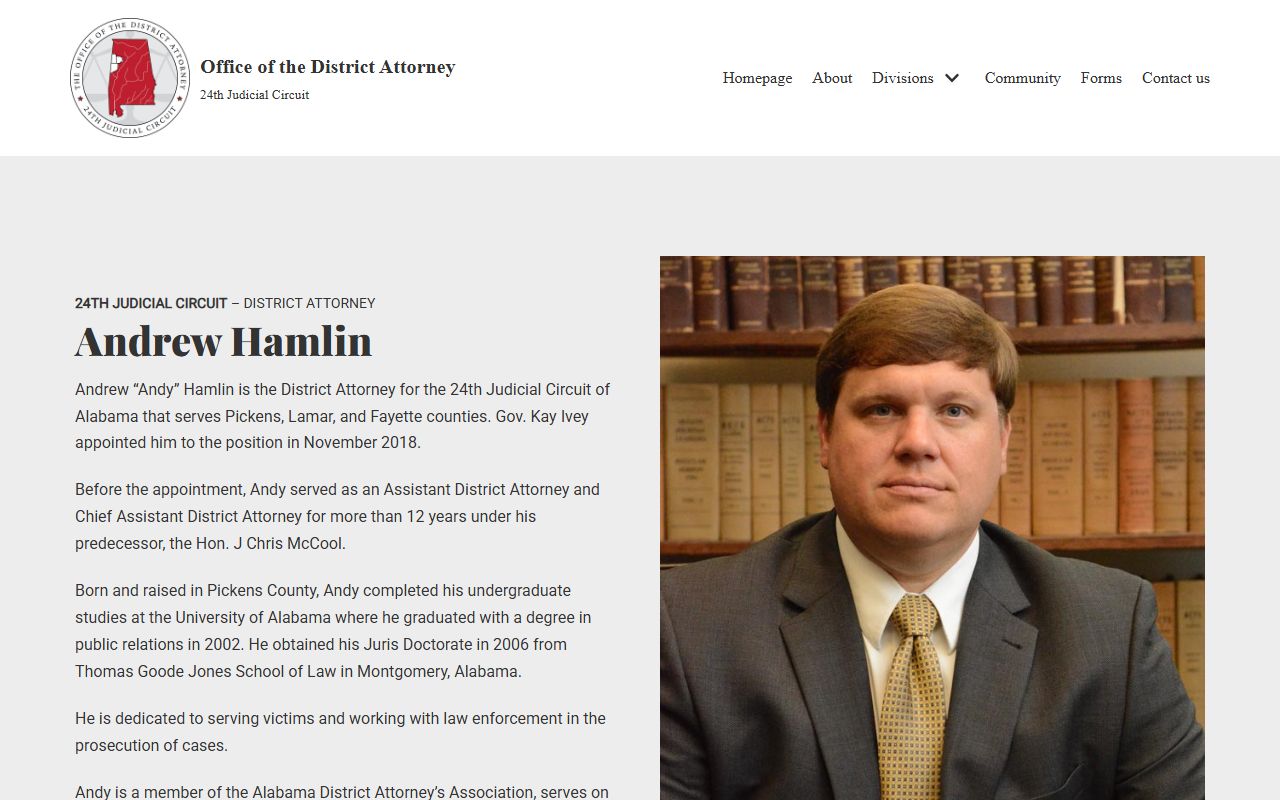
That prosecutor role explains why a jail booking may not match the final court charge once the case is reviewed and filed.
Restricted Fayette Arrest Records
Not every arrest-related record is open in the same way. The Fayette County Sheriff's Office may publish a current booking entry, while a court may restrict a juvenile matter, seal an eligible record, or show only limited online data. The sheriff may also withhold or redact records tied to active investigations, safety concerns, victim privacy, medical privacy, or records outside its custody.
When a public portal result does not match a jail record, do not assume the court has no case. The charge may be in a municipal court, still under review, spelled differently, older than the online index, restricted from public view, or not yet filed. The safe path is to confirm through the Fayette County Circuit Clerk, the issuing municipal court, or the sheriff's office when the question is about custody rather than court disposition.